


 English
 Español
 عربى
Anatomy of a Sofa: Frame, Suspension, Cushions, and Hidden Parts Explained
Anatomy of a Sofa: Frame, Suspension, Cushions, and Hidden Parts Explained
Anatomy of a Sofa: Frame, Suspension, Cushions, and Hidden Parts Explained
Anatomy of a Sofa: Frame, Suspension, Cushions, and Hidden Parts Explained
Anatomy of a Sofa: Frame, Suspension, Cushions, and Hidden Parts Explained
Anatomy of a Sofa: Frame, Suspension, Cushions, and Hidden Parts Explained
Anatomy of a Sofa: Frame, Suspension, Cushions, and Hidden Parts Explained
Anatomy of a Sofa: Frame, Suspension, Cushions, and Hidden Parts Explained
Anatomy of a Sofa: Frame, Suspension, Cushions, and Hidden Parts Explained
Anatomy of a Sofa: Frame, Suspension, Cushions, and Hidden Parts Explained
Anatomy of a Sofa: Frame, Suspension, Cushions, and Hidden Parts Explained
Anatomy of a Sofa: Frame, Suspension, Cushions, and Hidden Parts Explained
Anatomy of a Sofa: Frame, Suspension, Cushions, and Hidden Parts Explained
Anatomy of a Sofa: Frame, Suspension, Cushions, and Hidden Parts Explained
Anatomy of a Sofa: Frame, Suspension, Cushions, and Hidden Parts Explained
Anatomy of a Sofa: Frame, Suspension, Cushions, and Hidden Parts Explained

Product Category
NEW Category
Contact us
Anatomy of a Sofa: Frame, Suspension, Cushions, and Hidden Parts Explained
Content
- 1 The Main Parts of a Sofa at a Glance
- 2 The Frame: The Skeleton Under the Fabric
- 3 Suspension: What Happens the Moment You Sit Down
- 4 Cushions and Foam: Where Comfort Is Engineered
- 5 Upholstery and Padding: The Layers You Actually Touch
- 6 Arms, Backs and Legs: Where Structure Becomes Style
- 7 From Parts to Systems: Knock-Down and Modular Construction
- 8 A Checklist for Judging a Sofa in the Showroom
Most people judge a sofa with their eyes and their hands. They sit down, press a cushion, rub the fabric between two fingers. It is a reasonable way to start, but it only tells you how the sofa feels today. The anatomy of a sofa, meaning the frame, the suspension, the foam, the padding and the joinery hidden under a dust cover, is what decides how it feels five years from now. After nearly two decades of building seating for homes, offices and hospitality spaces, we have learned that the difference between a sofa that sags and one that keeps its shape rarely shows up in the showroom. This guide walks through every part, roughly in the order you would meet them if you took a sofa apart, and explains what each one actually does.
The Main Parts of a Sofa at a Glance
A sofa is a surprisingly simple object once you strip the fabric away. Almost every design, from a compact loveseat to a long modular sectional, is assembled from the same short list of components.
- Frame - the internal skeleton of rails, posts and corner blocks that carries every load.
- Suspension - the springs or webbing stretched across the seat platform.
- Seat core - the foam block, pocket spring unit or feather blend inside each seat cushion.
- Back support - either an upholstered back panel or separate loose back cushions.
- Arms - upholstered side panels that add structure and define the silhouette.
- Legs or base - the contact point with the floor and the element that sets visual weight.
- Upholstery and padding - the visible fabric or leather, plus the thin soft layers underneath it.
- Dust cover and decking - the fabric that closes the underside and hides the internals.
- Connectors - brackets, links and knock-down hardware that join modular or flat-packed pieces.
Working through that list from the bottom up is also the fastest way to compare two sofas that look identical on the shop floor. The visible parts sell the sofa; the hidden parts keep it.
The Frame: The Skeleton Under the Fabric
The frame is the part buyers never think about, and it is the part that governs everything else. A frame that flexes when you push on a corner will eventually work its joints loose, and once that happens no amount of good foam will rescue the sofa. In volume production, frames are built from one of a small number of materials.
| Frame material | Common use | Behaviour over time |
|---|---|---|
| Kiln-dried hardwood | Rails, posts, corner blocks | Holds screws well, resists warping |
| Hardwood plywood | Seat platforms, curved panels | Stable and consistent, good screw retention |
| MDF or particle board | Budget frames, inner panels | Heavy, weak at joints, prone to crumbling |
| Steel or aluminium | Bases, brackets, KD connectors | Very rigid, ideal for knock-down joints |
Why joinery matters as much as the wood
Two frames cut from the same hardwood can perform completely differently depending on how the corners are made. Butting two boards together and firing staples through them is the cheapest way to build a rectangle, and it is also the first thing to fail. A properly built corner uses glue, screws and a solid corner block, with the front rail acting as a bridge across the widest span. When those blocks are missing, the frame starts to rack, meaning it rocks side to side like a boat on choppy water, and the fabric begins to pull at the seams. If you want to know how seriously a manufacturer treats this detail, ask about corner blocks and the joinery schedule rather than the wood species. In our own factory, every frame is glued, screwed and blocked before it ever reaches the upholstery line, because fixing a loose frame later is impossible without stripping the sofa.
Suspension: What Happens the Moment You Sit Down
Suspension is the bridge between the frame and the cushion. It absorbs your weight, distributes it across the seat, and springs back thousands of times over the life of the sofa. There are a handful of systems you will meet, and each behaves differently.
- Sinuous (zig-zag) springs - steel wires fixed across the frame in a wave pattern. Efficient, light and by far the most common in modern production.
- Pocket springs - individual springs in fabric pockets, often used in higher-end seats for even support.
- Eight-way hand-tied springs - coil springs lashed together with twine in eight directions. Excellent, labour-intensive and now uncommon.
- Elastic webbing - woven straps stretched over the frame. Lightweight and inexpensive, best suited to lighter use.
- Rigid platform - a solid board with foam on top. Cheap and predictable, but it feels firm and unforgiving.
The practical test is simple. Press hard into the front edge of the seat and listen. A healthy suspension is quiet and returns smoothly; creaks, clicks and a hollow clunk usually point to thin wire or a poorly attached spring clip.
Cushions and Foam: Where Comfort Is Engineered
If the frame is the skeleton, foam is the muscle. Density and resilience matter far more than the softness you feel with your palm, because softness can be created cheaply by adding air to the mix. A low-density foam feels wonderful in the showroom and flattens within a year or two. Higher-density, high-resilience foam costs more and holds its loft for far longer, which is why commercial seating tends to use firmer, denser blocks and then soften the surface with a fibre wrap.
There are three families of seat core worth knowing. Moulded foam is the most predictable and the easiest to replace. Pocket spring units wrapped in foam give a more buoyant, mattress-like feel. Feather and fibre blends feel luxurious but need regular fluffing and are rarely the right choice for a busy office or reception area. Foam can also be compressed and vacuum-packed for transport, which is how many flat-packed and knock-down sofas travel without damage.
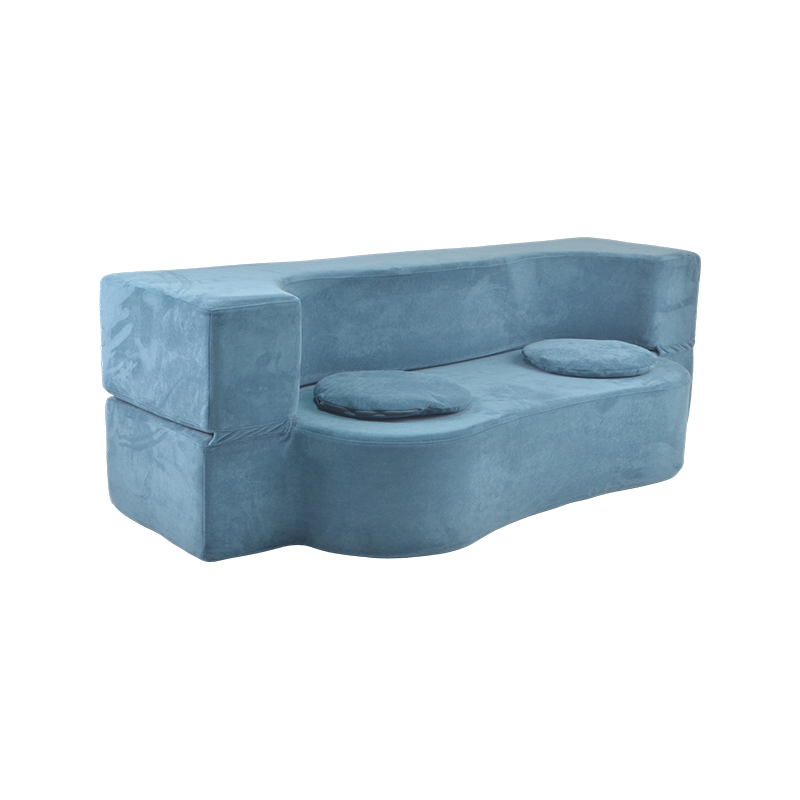
 Compressible Reversible Loveseat Sofa for Small SpacesIts compressible, reversible design and high-density foam seat make this loveseat a practical fit for compact apartments and small-space layouts.View Product →
One more detail sits directly under the cushion: the deck. A suspended deck lets air move and adds softness, while a solid deck feels firmer and lasts longer. Neither is wrong, but the two should not be mixed on the same sofa.
Upholstery and Padding: The Layers You Actually Touch
Upholstery is the visible face of the anatomy, and it is also the easiest part to fake. Fabric choice comes down to three questions: what it is made of, how tightly it is woven, and how many rubs it survives before the surface breaks down. Woven polyester blends are workhorses that resist pilling and clean up easily. Boucle and textured weaves look wonderful but trap dust and need brushing. Linen blends breathe beautifully and wrinkle just as beautifully. On the leather side, full-grain and top-grain hides age gracefully, while bonded and synthetic leather is a coated split that will eventually peel in high-wear spots.
Beneath the fabric sits the padding package that gives a sofa its soft shoulders. A thin layer of polyester fibre or a bonded wadding wraps the foam and smooths the transition between cushion and frame. Good padding is a small cost that makes a large difference, because it stops the frame edges from telegraphing through the fabric after a few months of use.
Arms, Backs and Legs: Where Structure Becomes Style
Arms are the most expressive part of a sofa, and they also carry real weight. A track or flare arm is straight and tailored, which suits tight spaces and modern interiors. An English arm is rolled inward and padded on top, so it doubles as a headrest. A classic rolled arm curves outward for a traditional look, and a slim armless design keeps a small room feeling open. What matters structurally is that the arm is tied into the frame rather than tacked onto the outside, because arms take the sideways load whenever someone leans on them.
 Classic Roll Arm Three-Seat Sofa with Bolster CushionsCurved roll arms, bolster cushions, and a reinforced hardwood frame define this three-seat sofa, offered in two sizes.View Product →
Backs follow the same logic. A tight back is upholstered directly onto the frame and holds its shape with no maintenance, while loose back cushions feel softer but need daily fluffing. Camelback and channel-tufted backs are styling choices layered over that basic decision. Legs, finally, are more than decoration. Tapered and turned timber legs lift a sofa visually and should be reinforced where they meet the rail; metal legs and plinth bases spread the load differently and often suit heavier contract use.
From Parts to Systems: Knock-Down and Modular Construction
Modern sofas increasingly arrive as systems rather than single objects. Knock-down construction uses bolts, cam locks and interlocking brackets so a frame can be shipped flat and assembled on site, which cuts freight volume and makes doorways much less of a problem. Modular construction goes a step further: a corner unit, an armless unit and an ottoman can be clipped or bolted together to form a two-seat, three-seat or L-shaped arrangement, then rearranged later. Both approaches live or die on the connectors. A modular sofa with thin brackets will squeak and separate; one with solid steel links and a rigid base will feel like a single piece of furniture.
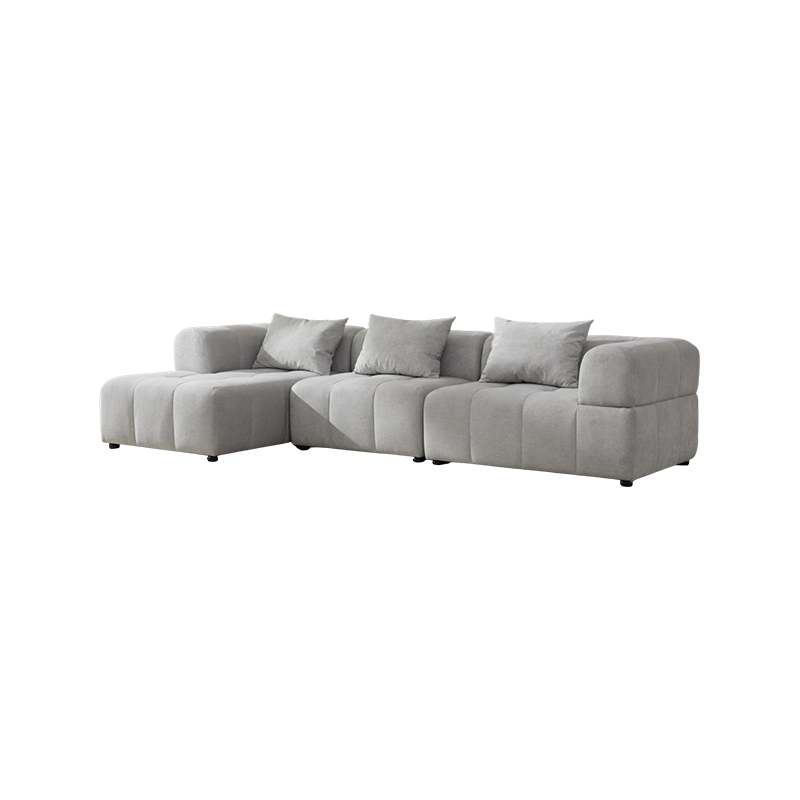 CENTAURI Modular Sofa with Configurable Chaise OptionsIts solid wood frame, high-density foam, and combinable single, double, or chaise units let you adapt the seating to different rooms.View Product →
This is the point where a manufacturer's engineering habits become visible. If you would like to see how frames, foam and connectors come together before they are covered in fabric, take a look at our production floor, where seating has been built since 2007 and shipped to more than forty countries.
A Checklist for Judging a Sofa in the Showroom
You cannot dismantle a sofa in a shop, but you can ask it a few direct questions with your hands and ears.
- Lift one corner a few centimetres off the floor. A single-piece frame follows; a wobbly, segmented one does not.
- Press hard into the front edge of the seat and listen for creaks or clicks.
- Check the seat cushion by folding it gently. It should resist and spring back, not crease permanently.
- Run a hand along the underside of the arm where it meets the frame. You should feel solid backing, not fabric over a hollow gap.
- Look under the sofa. A dust cover with a zip or staples and a tidy deck are signs of care.
- Sit in each position for a full minute, including the corner, and notice whether your weight sinks unevenly.
- Ask what the seat foam density is and how cushions can be replaced later.
Understanding the anatomy of a sofa turns a purchase from a matter of taste into a matter of judgement. Fabric and colour will always be the first thing you notice, and they should be. But the frame, the suspension, the foam and the connectors are doing the actual work, day after day, under a cover you will never open. Learn to ask about those four things and you will rarely end up with a sofa that disappoints you.
PREV:No previous article
NEXT:Knoll Herman Miller Merger: How It Reshaped Modern Office Furniture Design
NEXT:Knoll Herman Miller Merger: How It Reshaped Modern Office Furniture Design
Featured Products
Explore Our Featured Products

Featured News

- Mobile
- Contact Us
-
-
+86-139 0582 1355

-
alan@haoguofurniture.com

-
Approximately 210 meters south of the intersection of Le San Road and Sanwanqiao Road in Anji County, Huzhou City, Zhejiang Province, China

-
Copyright ©
Zhejiang HAOGUO Furniture Co., Ltd.
Rights Reserved.
 Office Chair Manufacturers
Dining Chair Manufacturers
