


 English
  Español
  عربى
عربى
Leather Office Chair Manufacturers: A Buyer’s Guide to Quality at
Leather Office Chair Manufacturers: A Buyer’s Guide to Quality at
Leather Office Chair Manufacturers: A Buyer’s Guide to Quality at
Leather Office Chair Manufacturers: A Buyer’s Guide to Quality at
Leather Office Chair Manufacturers: A Buyer’s Guide to Quality at
Leather Office Chair Manufacturers: A Buyer’s Guide to Quality at
Leather Office Chair Manufacturers: A Buyer’s Guide to Quality at
Leather Office Chair Manufacturers: A Buyer’s Guide to Quality at
Leather Office Chair Manufacturers: A Buyer’s Guide to Quality at
Leather Office Chair Manufacturers: A Buyer’s Guide to Quality at
Leather Office Chair Manufacturers: A Buyer’s Guide to Quality at
Leather Office Chair Manufacturers: A Buyer’s Guide to Quality at
Leather Office Chair Manufacturers: A Buyer’s Guide to Quality at
Leather Office Chair Manufacturers: A Buyer’s Guide to Quality at
Leather Office Chair Manufacturers: A Buyer’s Guide to Quality at
Leather Office Chair Manufacturers: A Buyer’s Guide to Quality at

Product Category
NEW Category
Contact us
Leather Office Chair Manufacturers: A Buyer’s Guide to Quality at
Content
When a North American office furniture chain requested a 40,000-unit run of leather executive chairs with identical stitch tension, 15-day lead-time tolerance, and BIFMA-level durability, only two manufacturers out of six qualified for the final shortlist. The differentiator was not price — it was documented consistency in raw material sourcing and production capacity that could absorb a 20% demand spike without subcontracting.
Buyers sourcing leather office chairs at scale quickly learn that the real cost driver is not the unit price, but the risk of late deliveries, non-conforming materials, and warranty claims. Identifying a manufacturer that controls its supply chain, holds an internal patent library, and maintains a floor-ready production volume of at least 1.5 million units per year transforms procurement from a recurring headache into a repeatable, low-drama process.
The Four Pillars of a Production-Ready Leather Office Chair Manufacturer
Most factory audits cover basic compliance. But leather office chair manufacturing adds layer upon layer of variable quality — from hide grading and frame joinery to foam density and mechanism lifecycle. When you demand identical SKUs across multiple containers and years of repeat orders, the manufacturer must demonstrate control in four specific areas.
| Criterion | Why It Matters | What to Verify |
|---|---|---|
| Material Chain Control | Prevents batch-to-batch color, texture, and wear-life drift in leather hides | Direct supplier relationships; on-site leather grading station |
| Production Capacity Depth | Absorbs sudden volume swings without sub-contracted, unvetted lines | Annual output >1.5M units; dedicated assembly lines for KD and multi-model runs |
| In-House R&D and Patents | Locks in proprietary mechanisms that reduce warranty rates and simplify servicing | Number of active patents; full-time technical team count |
| Global Compliance Record | Ensures chairs pass destination-market fire, tilt, and weight-capacity standards without costly redesign | Third-party test reports; green factory certifications; multi-region export history |
Manufacturers that meet all four criteria behave less like commodity suppliers and more like extension of your quality assurance team. The practical outcome is straightforward: fewer incoming inspections, lower defect-on-arrival rates, and the ability to forecast landed cost precisely.
Why Scale and Patent Portfolio Reduce Your Supply Risk
A leather office chair that looks premium in a showroom can fail within six months in a 12-hour-day dispatch center. The difference often lies in the seat-base connection, the tilt-lock mechanism’s cycle rating, and the leather’s UV and rub-fastness. Manufacturers that accumulate patents over decades — and fund an in-house technical team of 20 or more engineers — have already solved these failure modes inside their own prototyping lab.
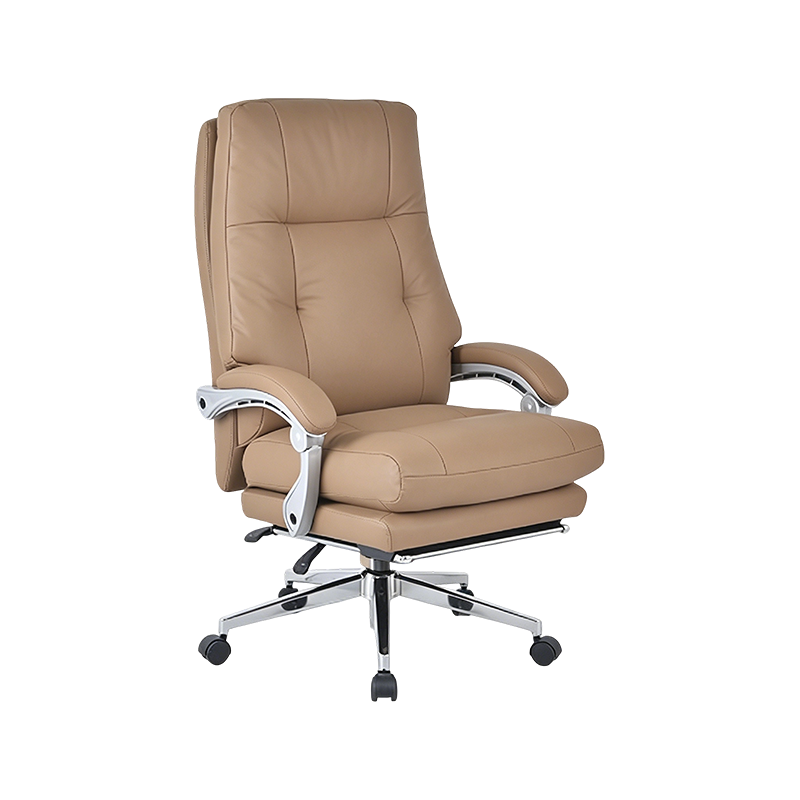
HAOGUO’s integrated production facility covers 63,000 square meters of manufacturing space and consistently outputs 2 million units annually across office, leisure, and gaming chair categories. With 68 product patents and a dedicated technical team, the plant designs its own locking tilts, adjustable armrests, and KD structures rather than assembling commodity components. That depth shows up on the buyer’s side as interchangeable parts, clean customs documentation, and fast re-orders without retooling delays. When you visit the R&D center, you see cycle-test rigs running 120,000 operations — not just a spec sheet promise.
Quality Control That Matches International Expectations
Export to over 40 countries across Europe, North America, the Middle East, and Asia forces a quality system to be stricter than any single regional standard. A manufacturer recognized as a national high-tech enterprise and green factory in China must simultaneously satisfy ANSI/BIFMA, EN 1335, and SGS load requirements without creating separate, lower-grade versions for different markets. That means every leather office chair rolling off the line is built to a unified specification that already covers BIFMA’s back-rest durability, stability, and caster-cycling thresholds.
During pre-shipment inspections, the key documents to request are not just the pass/fail certificate, but the detailed test data for leather abrasion (Martindale cycles), foam compression set, and mechanism endurance. Consistent suppliers provide these as part of the shipment dossier — not as a favor. That level of transparency is what turns a trial order into a five-year open contract.
A Practical Buying Checklist for Leather Office Chair Programs
Before engaging with leather office chair manufacturers, procurement teams should sharpen their RFQ to surface the right signals. Use this checklist as a go/no-go filter during factory evaluation:
- Confirm the manufacturer operates its own leather hide inspection station and has direct tannery contracts, not spot-market purchases.
- Ask for a list of active patent numbers and verify that at least one patent relates to a chair mechanism, base, or armrest assembly.
- Require a production schedule snapshot showing how they allocate dedicated lines for large runs while maintaining open capacity for repeat orders.
- Review last three export shipping documents to validate consistency in container utilization and packing configuration for KD models.
- Request a sample production timing study: from hide cutting to finished pallet, target under 35 working days for standard leather executive chairs.
Manufacturers that answer all five points with data instead of anecdotes are the ones you treat as strategic partners. They turn the search for leather office chair manufacturers into a single-vendor relationship with multi-year predictability — exactly what high-volume office furniture buyers need.
PREV:Accent Chairs 101: Everything You Need to Know Before You Make a Purchase
NEXT:Ergonomic Office Chair Manufacturers – B2B Guide to Quality Factories
NEXT:Ergonomic Office Chair Manufacturers – B2B Guide to Quality Factories
Featured Products
Explore Our Featured Products

Featured News

- Mobile
- Contact Us
-
-
+86-139 0582 1355

-
alan@haoguofurniture.com

-
Approximately 210 meters south of the intersection of Le San Road and Sanwanqiao Road in Anji County, Huzhou City, Zhejiang Province, China

-
Copyright ©
Zhejiang HAOGUO Furniture Co., Ltd.
Rights Reserved.
 Office Chair Manufacturers
Dining Chair Manufacturers
Office Chair Manufacturers
Dining Chair Manufacturers
