


 English
  Español
  عربى
عربى
What Should You Look for When Choosing a Leather Office Chair?
What Should You Look for When Choosing a Leather Office Chair?
What Should You Look for When Choosing a Leather Office Chair?
What Should You Look for When Choosing a Leather Office Chair?
What Should You Look for When Choosing a Leather Office Chair?
What Should You Look for When Choosing a Leather Office Chair?
What Should You Look for When Choosing a Leather Office Chair?
What Should You Look for When Choosing a Leather Office Chair?
What Should You Look for When Choosing a Leather Office Chair?
What Should You Look for When Choosing a Leather Office Chair?
What Should You Look for When Choosing a Leather Office Chair?
What Should You Look for When Choosing a Leather Office Chair?
What Should You Look for When Choosing a Leather Office Chair?
What Should You Look for When Choosing a Leather Office Chair?
What Should You Look for When Choosing a Leather Office Chair?
What Should You Look for When Choosing a Leather Office Chair?

Product Category
NEW Category
Contact us
What Should You Look for When Choosing a Leather Office Chair?
Content
- 1 Why the Right Leather Office Chair Makes a Real Difference
- 2 Understanding Leather Types Before You Buy
- 3 Ergonomic Features That Protect Your Body Over Long Hours
- 4 Adjustability Range and How to Match It to Your Body
- 5 Frame, Base, and Construction Quality Indicators
- 6 Practical Checklist Before Making Your Final Decision
Why the Right Leather Office Chair Makes a Real Difference
A leather office chair is one of the most used pieces of furniture in any workspace. For professionals who spend six to ten hours a day seated at a desk, the chair they sit in directly influences their posture, physical comfort, concentration, and long-term spinal health. Choosing incorrectly — selecting a chair that looks impressive but lacks proper ergonomic support, or buying cheap bonded leather that cracks and flakes within a year — leads to discomfort, distraction, and avoidable replacement costs. Choosing well means investing in a chair that supports the body correctly, holds up to years of daily use, and maintains its appearance throughout.
The leather office chair category spans an enormous range, from entry-level bonded leather task chairs priced under $150 to full-grain executive chairs upholstered in premium top-grain or genuine leather that cost several thousand dollars. Between these extremes lies a practical selection process guided by a clear set of criteria: leather quality, ergonomic features, adjustability range, frame and base construction, and the fit between the chair's dimensions and the user's body. Working through each criterion systematically produces a shortlist of chairs that genuinely match your requirements rather than simply matching an aesthetic or a price point.
Understanding Leather Types Before You Buy
The single most important material decision in selecting a leather office chair is understanding the difference between leather grades, because this determines not only the upfront cost but the long-term durability and appearance of the chair. The term "leather" is applied to products ranging from genuine full-grain hide to heavily processed bonded sheets that contain as little as 10–20% leather fibre. Each grade performs very differently in daily office use.
Full-Grain and Top-Grain Leather
Full-grain leather is cut from the outermost layer of the hide and retains the natural grain surface intact. It is the strongest and most breathable leather grade, and it develops a patina over time that many users find attractive. Top-grain leather has the surface sanded lightly to remove natural imperfections, then finished with a protective coating. It is slightly less durable than full-grain over decades but more uniform in appearance and more resistant to staining. Both grades are genuinely durable for office chair applications — a well-made top-grain leather chair used daily for eight hours can maintain its integrity and appearance for ten to fifteen years or more with basic care. These are the grades to prioritise if longevity and authentic material quality are priorities.
Genuine Leather and Split Leather
Genuine leather — despite its authoritative name — is a mid-grade material produced from the lower layers of the hide remaining after the top-grain is removed. It is real leather but lacks the density and natural fibre structure of top-grain, making it more susceptible to cracking and wear under prolonged use. Split leather is similarly produced from the fibrous inner hide layers and is typically given a polyurethane coating to simulate a grain pattern. Both grades are acceptable for light-use chairs or for users who sit for fewer hours per day, but for intensive professional use they will show visible wear within three to five years.
Bonded Leather and PU Leather
Bonded leather is manufactured by grinding leather scraps and fibres, bonding them with polyurethane, and laminating the composite onto a fabric backing. The surface looks and feels like leather initially but has almost none of the structural strength of genuine hide. In warm or humid environments — which office chairs frequently experience from body heat — the bonding adhesive breaks down within two to three years, causing the surface to crack, peel, and flake in large sections. PU (polyurethane) leather contains no leather content at all and is an entirely synthetic material. While modern PU leather can be visually convincing and is easier to clean than genuine leather, it does not breathe and tends to feel uncomfortably warm during long sitting sessions. These materials may be acceptable for occasional-use chairs in reception areas or meeting rooms, but they are poor choices for primary office seating used daily.
Ergonomic Features That Protect Your Body Over Long Hours
A leather office chair that lacks proper ergonomic design will cause physical discomfort regardless of how premium the upholstery is. Ergonomics — the science of fitting furniture to the human body — determines whether a chair supports natural spinal curves, reduces pressure on the lower back and thighs, and allows the arms and shoulders to remain in a relaxed, neutral position. The following ergonomic features are not optional enhancements but fundamental requirements for any chair used for extended periods of seated work.
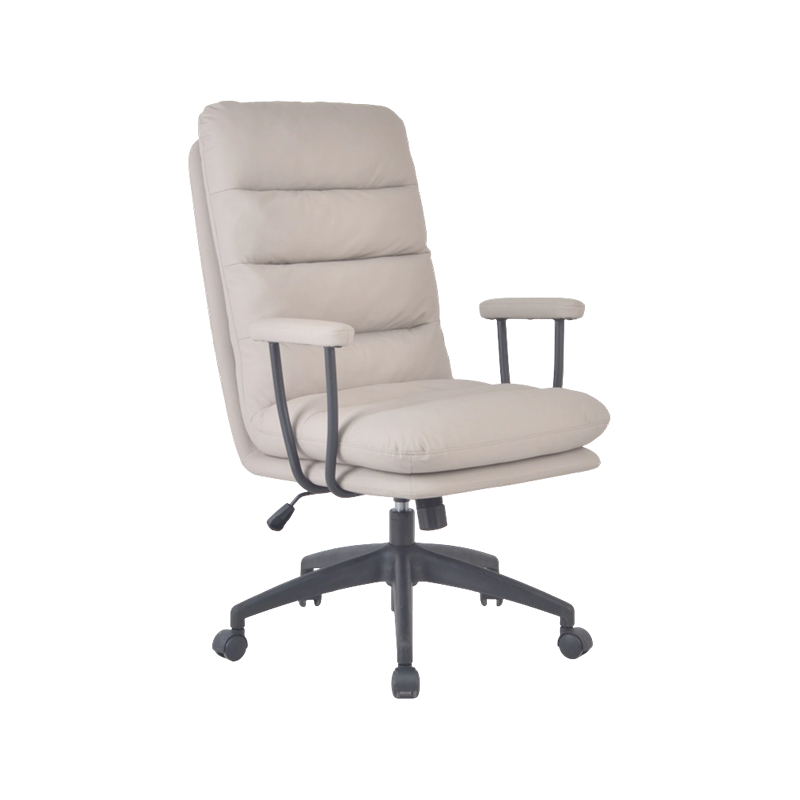
- Lumbar support: The lower back has a natural inward curve (lordosis) that flattens when unsupported seating allows the pelvis to tilt backward. A well-designed lumbar support — either a fixed contoured backrest or an adjustable lumbar pad — maintains this curve and prevents the lower back muscle fatigue that is the leading cause of chronic back pain among office workers.
- Seat depth and pan angle: The seat should be deep enough to support the full length of the thighs without the front edge pressing into the backs of the knees, which restricts circulation. A waterfall (rounded) front seat edge or an adjustable seat pan tilt reduces this pressure significantly. Standard seat depth ranges from 40 to 52 cm; taller users typically need deeper seats.
- Backrest height and recline: The backrest should support the full length of the spine from the lumbar region to the upper back. A recline mechanism that allows the backrest to tilt between approximately 100° and 120° from vertical reduces spinal disc pressure significantly compared to a fixed upright position — even small angles of recline measurably reduce loading on the lumbar vertebrae.
- Headrest: An adjustable headrest is particularly valuable for executive leather chairs used by individuals who read or take calls while seated. It supports the neck and reduces upper trapezius muscle tension, which is a common contributor to tension headaches and neck pain in desk workers.
- Armrests: Armrests should support the forearms at a height where the shoulders are relaxed and the elbows are at approximately 90°. Fixed-height armrests are a compromise that fits few users well; height-adjustable armrests (2D) or multi-directional armrests (4D) that also adjust inward, outward, forward, and backward provide a much better fit across different body types and desk heights.
Adjustability Range and How to Match It to Your Body
A leather office chair with excellent ergonomic design is only effective if its adjustment range covers the user's actual body dimensions. Before purchasing, measure your seated height (floor to the back of the knee when seated), your torso length, and your shoulder width, then compare these against the chair's specified adjustment ranges. A mismatch — for example, a chair with a minimum seat height of 48 cm used by someone whose knee height is 42 cm — cannot be correctly set up regardless of how many adjustment mechanisms it includes.
| Adjustment Feature | Typical Range | Why It Matters |
| Seat height | 40–55 cm | Allows feet to rest flat; aligns thighs parallel to floor |
| Lumbar height | 17–22 cm from seat | Positions support at the user's lumbar curve |
| Backrest recline | 90°–125° | Reduces lumbar disc pressure during long sitting periods |
| Armrest height | 20–30 cm from seat | Keeps shoulders relaxed; prevents neck tension |
| Seat depth | 40–52 cm | Prevents edge pressure on the back of the knees |
| Headrest height | Adjustable ±5 cm | Supports the neck without pushing the head forward |
Frame, Base, and Construction Quality Indicators
The structural components beneath the leather upholstery determine the chair's load-bearing capacity, stability, and long-term mechanical reliability. These components are rarely visible at the point of purchase but have a substantial impact on how the chair performs and how long it remains safe to use.
Seat Frame and Foam Density
The seat frame is typically constructed from steel, aluminium, or high-density moulded plywood. Steel and aluminium frames offer the best long-term rigidity and are standard in commercial-grade chairs. The foam padding bonded to the frame and covered by the leather upholstery should be high-density (at minimum 45 kg/m³ for the seat cushion) to resist permanent compression — the process by which low-density foam gradually flattens under body weight, creating a hard, unsupportive seat within twelve to eighteen months of daily use. Some premium leather chairs use a combination of high-density foam with a memory foam top layer, which provides both long-term structural support and immediate comfort contouring.
Five-Star Base and Castors
A five-star base is the industry standard for office chair stability, distributing the user's weight across five contact points to prevent tipping. Bases are made from nylon (polypropylene), aluminium alloy, or steel. Nylon bases are adequate for users up to approximately 120 kg in standard office environments; aluminium and steel bases are significantly stronger and are the correct choice for heavy-duty use or for chairs with weight ratings above 130–150 kg. The castors should be matched to the floor surface: hard twin-wheel castors for carpeted floors and rubber-coated castors for hard floors such as timber, tile, or polished concrete, to prevent surface scratching and provide smooth, controlled rolling.
Practical Checklist Before Making Your Final Decision
Before committing to a specific leather office chair, run through the following practical considerations to confirm the chair is the right fit for your specific situation:
- Verify the leather grade in writing: Ask the supplier for written confirmation of the leather grade (full-grain, top-grain, genuine, bonded, or PU). Marketing terms like "Italian leather," "executive leather," or "premium leather" have no standardised meaning and should not be relied upon without clarification of the actual grade.
- Check the weight capacity rating: Every chair has a maximum rated load. Confirm this exceeds your body weight by a comfortable margin — ideally at least 20 kg above your actual weight — to avoid operating the chair near its structural limit.
- Sit in the chair for at least 15 minutes if possible: Initial comfort impressions formed in the first few seconds are unreliable. Pressure points and support deficiencies typically only become apparent after ten to fifteen minutes of seated use. If purchasing online, prioritise suppliers with a generous return policy.
- Confirm the warranty terms: A quality leather office chair should carry a minimum two-year warranty covering the frame, mechanism, and upholstery. Shorter warranty periods — particularly on the upholstery — are often an indicator of low leather grade or low-density foam that the manufacturer expects to show wear quickly.
- Consider the office climate: Leather is warmer than mesh or fabric upholstery. In offices without air conditioning or in warm climates, genuine leather's natural breathability helps manage this, but bonded leather and PU leather trap heat significantly. If your office runs warm, this should be a decisive factor in favour of top-grain or full-grain leather over synthetic alternatives.
- Factor in maintenance: Genuine leather requires periodic conditioning — typically every six to twelve months — with a leather conditioner to prevent the hide from drying and cracking. This is a minor time investment that dramatically extends the chair's appearance and lifespan. Budget for leather cleaner and conditioner as part of the total ownership cost.
A leather office chair chosen with careful attention to material grade, ergonomic specification, adjustability range, and structural quality will serve as a comfortable, reliable, and visually distinctive piece of office furniture for many years. The effort invested in making an informed selection at the outset pays dividends in daily comfort, reduced physical strain, and the avoidance of premature replacement costs that inevitably follow a purchase decision made on appearance alone.
PREV:Why Is a Modular Seat Sofa the Smartest Seating Investment for a Modern Home?
NEXT:The Origin Of Chair
NEXT:The Origin Of Chair
Featured Products
Explore Our Featured Products

Featured News

- Mobile
- Contact Us
-
-
+86-139 0582 1355

-
alan@haoguofurniture.com

-
Approximately 210 meters south of the intersection of Le San Road and Sanwanqiao Road in Anji County, Huzhou City, Zhejiang Province, China

-
Copyright ©
Zhejiang HAOGUO Furniture Co., Ltd.
Rights Reserved.
 Office Chair Manufacturers
Dining Chair Manufacturers
Office Chair Manufacturers
Dining Chair Manufacturers
