


 English
  Español
  عربى
عربى
What Should You Look for in a Home Office Chair for Comfortable Daily Work?
What Should You Look for in a Home Office Chair for Comfortable Daily Work?
What Should You Look for in a Home Office Chair for Comfortable Daily Work?
What Should You Look for in a Home Office Chair for Comfortable Daily Work?
What Should You Look for in a Home Office Chair for Comfortable Daily Work?
What Should You Look for in a Home Office Chair for Comfortable Daily Work?
What Should You Look for in a Home Office Chair for Comfortable Daily Work?
What Should You Look for in a Home Office Chair for Comfortable Daily Work?
What Should You Look for in a Home Office Chair for Comfortable Daily Work?
What Should You Look for in a Home Office Chair for Comfortable Daily Work?
What Should You Look for in a Home Office Chair for Comfortable Daily Work?
What Should You Look for in a Home Office Chair for Comfortable Daily Work?
What Should You Look for in a Home Office Chair for Comfortable Daily Work?
What Should You Look for in a Home Office Chair for Comfortable Daily Work?
What Should You Look for in a Home Office Chair for Comfortable Daily Work?
What Should You Look for in a Home Office Chair for Comfortable Daily Work?

Product Category
NEW Category
Contact us
What Should You Look for in a Home Office Chair for Comfortable Daily Work?
Content
- 1 Why Your Home Office Chair Matters More Than You Think
- 2 Core Ergonomic Features Every Home Office Chair Should Have
- 3 Pneumatic Height Adjustment: Why This Feature Is Non-Negotiable
- 4 Five-Star Caster Base: Stability, Mobility, and Floor Protection
- 5 Children's Home Office Chairs: Sizing and Safety Considerations
- 6 Upholstery and Colour Options: Matching the Chair to the Home Environment
- 7 A Practical Checklist for Selecting a Home Office Chair
Why Your Home Office Chair Matters More Than You Think
The home office chair is one of the most consequential purchases in any remote or hybrid work setup, yet it is frequently treated as a secondary consideration behind desk choice, monitor placement, or technology equipment. This is a mistake with real physical consequences. Adults working from home typically spend six to nine hours per day seated, and the quality of their seating directly determines whether those hours accumulate into chronic back pain, neck tension, and postural problems — or pass comfortably without lasting physical effect. Unlike a commercial office environment where ergonomic furniture is often provided and regularly updated, the home office worker selects and funds their own seating, which means that decision carries full responsibility for long-term physical wellbeing.
The home office chair market has expanded significantly alongside the growth of remote work, and the range of available products now spans from budget task chairs under $100 to fully adjustable ergonomic models at several times that price. Within this range, the challenge for buyers is identifying which features genuinely improve comfort and health outcomes and which are marketing additions that sound impressive but make little practical difference. Understanding the core functional requirements of a home office chair — and how different product designs address them — is the foundation of a well-informed purchase decision.
Core Ergonomic Features Every Home Office Chair Should Have
Ergonomic design in office seating is not an optional premium — it is the functional baseline that separates seating that supports the body from seating that simply holds a person upright. The following features define a chair's ergonomic capability and should be evaluated for every home office chair purchase regardless of budget level.
Lumbar Support for the Lower Back
The lumbar spine has a natural inward curve that flattens when a person sits without adequate lower back support, causing the pelvis to rotate backward and placing uneven compressive load on the intervertebral discs. Over hours of daily exposure, this loading pattern is a primary driver of lower back pain in sedentary workers. A home office chair with effective lumbar support — either a contoured backrest shaped to follow the natural spinal curve or an adjustable lumbar pad that can be positioned at the correct height for the individual user — prevents this flattening and maintains the spine in a structurally neutral position. Adjustable lumbar support is preferable to fixed because the lumbar curve sits at different heights in different people depending on torso length, and a fixed support positioned incorrectly provides little benefit.
Seat Depth and Cushion Firmness
Seat depth — the front-to-back dimension of the seat pan — must be matched to the user's thigh length. A seat that is too deep presses the front edge into the backs of the knees, restricting blood circulation in the lower legs and causing numbness and discomfort within thirty to sixty minutes. A seat that is too shallow fails to support the full thigh length, concentrating body weight on a smaller area and increasing pressure on the sitting bones. The ideal seat depth positions the front edge approximately 5–8 cm from the back of the knees when the user is seated with their back against the backrest. Cushion firmness matters equally: high-density foam maintains its support profile through years of use, while low-density foam collapses within one to two years, converting a formerly comfortable seat into a hard, unsupportive surface.
Backrest Height and Recline Capability
The backrest should extend high enough to support the full length of the spine from the lumbar region through the thoracic vertebrae to the upper back. Mid-back chairs that end below the shoulder blades leave the upper back unsupported, which leads to forward head posture and upper trapezius tension — a common complaint among home office workers who spend long periods reading or writing on screen. A recline mechanism that allows the backrest to tilt between 100° and 120° from vertical reduces spinal disc pressure significantly and is particularly valuable for workers who take calls or read documents while seated, as it distributes body weight more evenly across the backrest and reduces the static loading on the lumbar region.
Pneumatic Height Adjustment: Why This Feature Is Non-Negotiable
Pneumatic height adjustment — the gas cylinder mechanism that allows a chair's seat height to be raised or lowered with a lever while seated — is a standard feature across well-designed home office chair ranges, and its inclusion is not a luxury but a functional necessity. The correct seated working height varies between individuals based on leg length, desk height, and the height of monitor or screen placement, and no single fixed chair height can accommodate this variation across different users.
The correct seat height positions the user's feet flat on the floor with the knees at approximately 90° and the thighs parallel to the ground. At this height, the arms can rest on the desk or keyboard at a position where the shoulders are relaxed and the elbows are at roughly 90°, and the eyes are level with the top third of the monitor screen without the neck tilting upward or downward. A chair that cannot be adjusted to this position for a specific user — because its height range does not cover that individual's requirements — forces compensatory postures that accumulate into discomfort over the workday. Standard pneumatic cylinders on home office chairs typically provide a height range of approximately 42–55 cm from floor to seat surface, covering the majority of adult users; extended-range cylinders are available for taller individuals.
The quality of the gas cylinder also affects the long-term reliability of this adjustment. A well-manufactured pneumatic cylinder maintains its set height without slow sinking during use — a common failure mode in lower-quality cylinders where the internal seal degrades and allows the chair to gradually drop under load. Specifying chairs with cylinders from established component manufacturers reduces this failure risk and extends the service life of the height adjustment mechanism.
Five-Star Caster Base: Stability, Mobility, and Floor Protection
The five-star caster base is the universal standard for office chair stability, and its geometry is specifically engineered to prevent tipping under the range of off-centre loads that occur during normal seated use — leaning sideways to reach a drawer, turning to speak to someone beside the desk, or shifting weight while changing position. A four-star base covers less floor area per arm, reducing stability margin, while a five-star design distributes the chair's weight and the user's body weight across five contact points equally spaced around the base circumference, providing a stable platform that resists tipping in any direction.
Caster selection should be matched to the floor surface in the home office. Hard twin-wheel nylon castors roll smoothly on carpet and low-pile rugs, but on hard floor surfaces — timber, laminate, tile, or polished concrete — they can scratch the surface finish and roll with less control than desirable. Rubber-coated or polyurethane castors are the correct choice for hard floors: the softer wheel material grips the surface more effectively, rolls quietly, and does not mark or scratch the floor. In home office environments where the chair moves between different floor zones, dual-material castors that perform acceptably on both carpet and hard floors are available and worth specifying.
Children's Home Office Chairs: Sizing and Safety Considerations
The expansion of home schooling, hybrid education models, and children's participation in digital learning has created genuine demand for home office chairs sized for younger users. Standard adult office chairs are dimensionally mismatched to children's bodies in ways that are not simply a matter of scale — the ergonomic problems created by a child using an adult-sized chair are acute rather than marginal. An adult chair's minimum seat height is typically too high for a primary school-age child to sit with feet on the floor; the seat depth is too long, pressing the front edge into the back of the child's knees; and the backrest height positions lumbar support at the wrong point on a shorter spine.
Children's home office chairs address these issues with proportionally reduced dimensions: lower minimum seat heights (often 32–42 cm), shorter seat depths, lower backrests, and narrower seat widths that match a child's smaller frame. The same pneumatic height adjustment and five-star caster base features found in adult models are included in properly designed children's chairs, scaled appropriately. For families where multiple children of different ages share a workspace, chairs with a wide enough height range to serve children across a range of school years provide longer useful service before the child outgrows the chair's adjustment range. Retailers and importers targeting family household segments can serve this demand effectively by stocking children's chair models alongside standard adult versions from the same product line.
Upholstery and Colour Options: Matching the Chair to the Home Environment
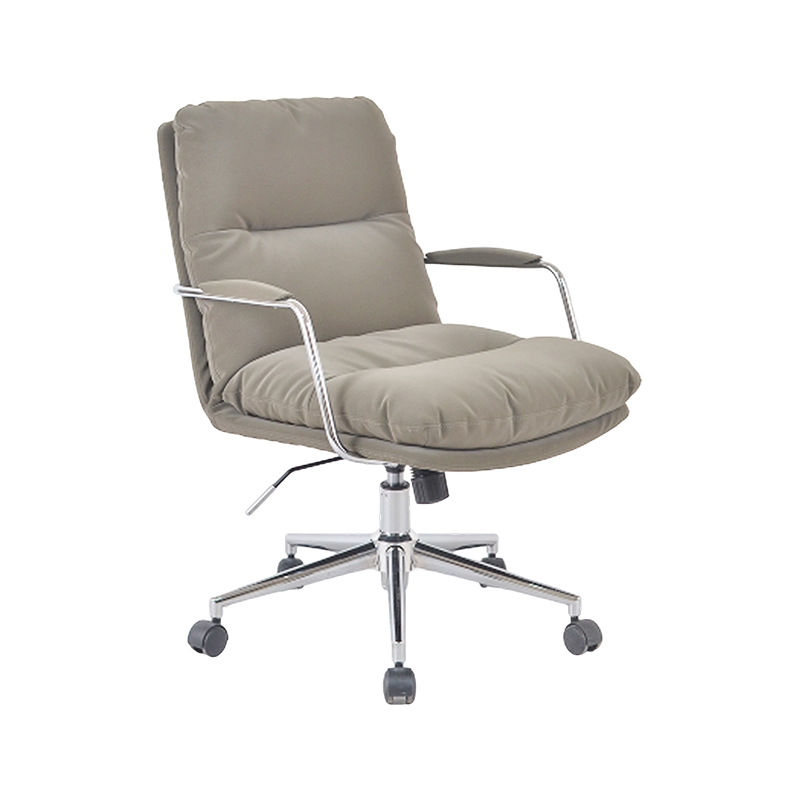
A home office chair occupies a visible position in a living environment rather than a standardised commercial workspace, which means aesthetic compatibility with the home's interior design is a legitimate selection criterion alongside ergonomic performance. The upholstery material and colour of the chair affect how it integrates visually with furniture, wall colours, and decorative elements in the room — a consideration that carries more weight in a home setting than in a conventional office.
| Upholstery Type | Key Properties | Best For |
| Fabric (woven) | Breathable, wide colour range, soft hand feel | General home office use, warmer climates |
| Mesh (back panel) | Maximum airflow, modern aesthetic, lightweight | Long work sessions, rooms without air conditioning |
| PU Leather | Easy to wipe clean, professional appearance | Households with children, home offices doubling as meeting spaces |
| Genuine Leather | Premium appearance, durable, develops patina | Executive home offices, high-use adult workstations |
OEM upholstery and colour customisation — offered by manufacturers as a procurement option for importers and retail buyers — allows market-specific product selections to be built without altering the chair's core construction or ergonomic specification. An importer targeting Scandinavian residential markets can specify neutral fabric tones and clean-line aesthetics; one targeting Southeast Asian apartment retail can select colours and materials suited to warmer climates and contemporary urban interiors. This flexibility means the same proven chair platform can serve multiple market segments through surface customisation, reducing sourcing complexity while expanding the commercial reach of the product range.
A Practical Checklist for Selecting a Home Office Chair
Applying the criteria above to a specific purchase decision is most effective when approached systematically. The following checklist summarises the key questions to answer before committing to a home office chair.
- Does the seat height range cover your measurements? Measure your floor-to-knee height while seated and confirm the chair's pneumatic adjustment range includes that figure, with room to fine-tune up and down.
- Is the lumbar support adjustable or appropriately positioned? If fixed, confirm the lumbar contour sits at your lower back curve, not at mid-back or below the waist, both of which provide minimal benefit.
- What is the foam density specification? A minimum of 45 kg/m³ for the seat cushion is the standard for residential chairs expected to remain comfortable through several years of daily use.
- Is the base material appropriate for your weight and use intensity? Nylon bases suit standard use up to approximately 120 kg; aluminium or steel bases are advisable for heavier users or for chairs used for extended hours daily.
- Are the castors suited to your floor surface? Hard floors require rubber or polyurethane castors to prevent scratching; carpet floors work well with standard nylon twin-wheel castors.
- If purchasing for a child, is the chair dimensioned for their current height range? Check the minimum seat height and seat depth against the child's measurements, and consider the height adjustment range for how many years of growth it will accommodate.
- Does the upholstery material suit your climate and cleaning requirements? Fabric breathes better in warm rooms; PU leather cleans more easily in households with children or pets; genuine leather offers the longest lifespan with appropriate maintenance.
- What warranty is provided on the mechanism and upholstery? A minimum two-year warranty on the gas cylinder, tilt mechanism, and upholstery is reasonable for a well-made home office chair; shorter warranty periods indicate lower expected component durability.
A home office chair chosen against these criteria — combining correct ergonomic specification, reliable mechanical components, appropriate upholstery for the environment, and dimensional fit for the user — will provide comfortable, stable, functional seating through years of daily work. The time spent evaluating options carefully at the point of purchase is a small investment compared to the cumulative hours spent in the chair and the physical and productivity costs of getting that decision wrong.
PREV:How Do You Choose the Perfect Loveseat Sofa for Comfort and Style?
NEXT:Why Is a Modular Seat Sofa the Smartest Seating Investment for a Modern Home?
NEXT:Why Is a Modular Seat Sofa the Smartest Seating Investment for a Modern Home?
Featured Products
Explore Our Featured Products

Featured News

- Mobile
- Contact Us
-
-
+86-139 0582 1355

-
alan@haoguofurniture.com

-
Approximately 210 meters south of the intersection of Le San Road and Sanwanqiao Road in Anji County, Huzhou City, Zhejiang Province, China

-
Copyright ©
Zhejiang HAOGUO Furniture Co., Ltd.
Rights Reserved.
 Office Chair Manufacturers
Dining Chair Manufacturers
Office Chair Manufacturers
Dining Chair Manufacturers
